Service · Wine storage
Sub-Zero Wine Preservation Repair
A wine unit can glow, hum and show a sensible number while quietly failing at its real job. What bottles need is steadiness and moisture, so here every Sub-Zero wine cabinet, tall or undercounter, gets judged on those two tests first.
- Online, any hourBook a visit
- Call 24/7(310) 706-2347
- Per visit, not per unit$89
- House calls, every day8–6
Steady beats exact
Wine does not ask for a perfect number; it asks for one that never wanders. Roughly 55°F is where most cellar guidance lands for long keeping, yet a bottle parked at 57°F all year is better off than one bouncing between 50 and 60 because a compressor short-cycles or the door swings open all evening during a dinner party.
Each swing makes the liquid swell and shrink. Over months that breathing works on the cork, can nudge wine past it, and lets air seep back in. Heat hurries aging along in ways nobody wanted. Excess cold is gentler but stalls development and may drop tartrate crystals in whites.
Humidity is the second half of the job. A cork that dries out shrinks, stops gripping the neck, and oxygen begins reaching the wine. Too much moisture matters less for what is inside and more for the outside: labels mildew and peel, which hurts any bottle you might one day sell. Sub-Zero designs its wine storage around both — dedicated temperature zones plus humidity held in the band wine prefers.
So the honest test is not whether the cabinet feels cold. It is whether it stays steady and stays moist. If your wine storage is an undercounter model sitting beside refrigerator drawers, the drawer repair page covers its neighbors; for the deeper science, see why storage conditions matter.
Direct reply 1/3
What humidity should a wine refrigerator have?
Target a relative-humidity reading from 60 up to about 70 on an inexpensive hygrometer. Drier than that, corks gradually shrink and admit oxygen; much damper, labels mildew and glass fogs. Leave the gauge among the bottles overnight — it shows where your cabinet truly sits before anyone suspects a part.
When the unit stops holding temperature
Direct reply 2/3
Why is my Sub-Zero wine cooler not cooling?
Mostly heat with no exit — lint coating the condenser, something parked against the toe grille, a fan that quit. After those: a tired gasket, a misreading thermistor, a confused control board. If the display sits more than a couple of degrees off its setting and stays there, have it diagnosed before bottles warm through.
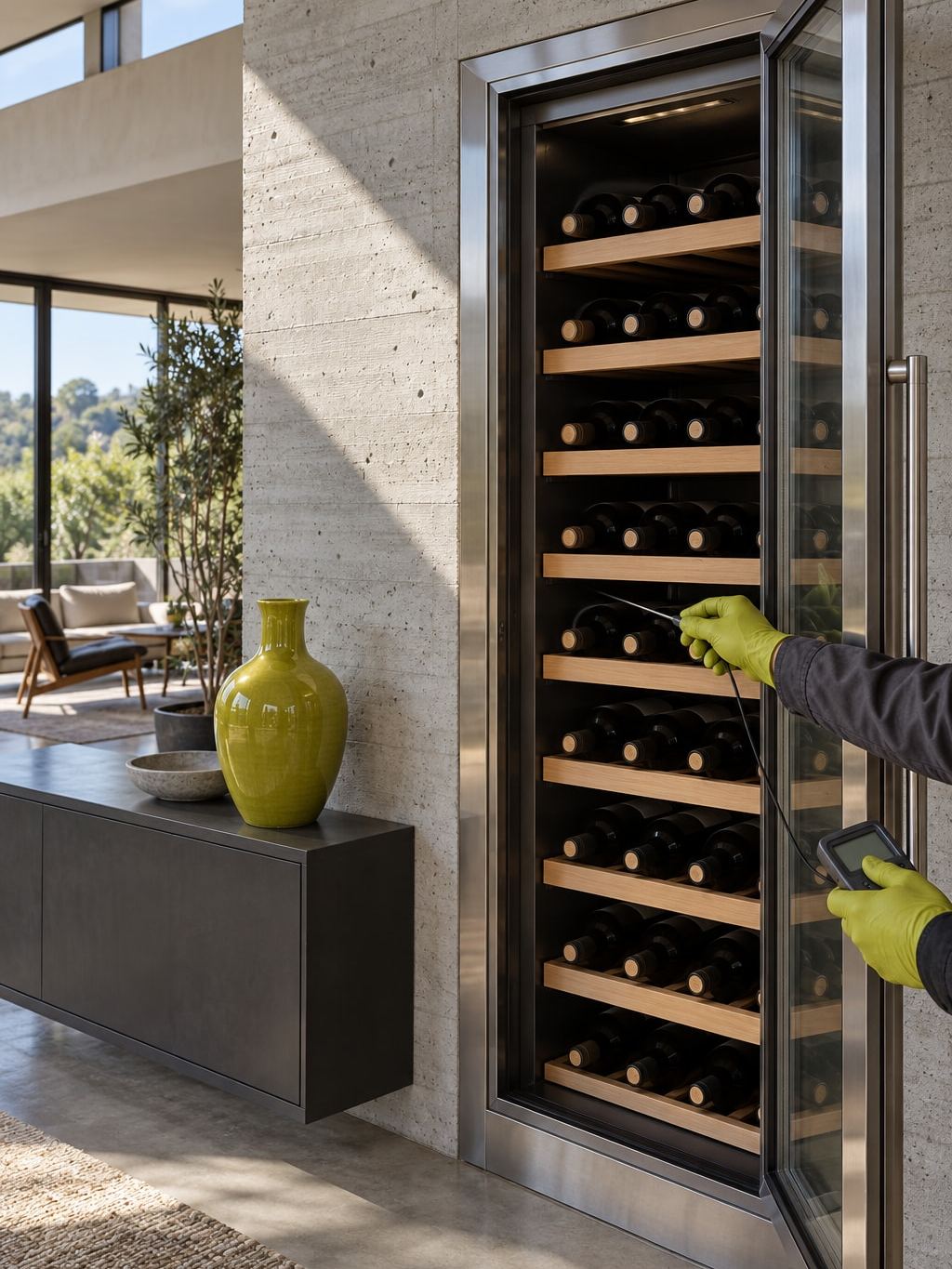
Signs the collection is at risk
None of these mean the bottles are already harmed. They mean the cabinet has stopped doing part of its job, and the clock is running.
- Repair page
Display creeping a few degrees over the setting and parking there
Likely Heat not escaping: dusty condenser, a tiring condenser or evaporator fan, or the early stage of a sealed-system fault
-
Temperature rising and falling more than it used to
Likely A sensor drifting, a control cycling erratically, or the door seal letting room air through
-
Fog or beads of water inside the glass door
Likely Humidity running too high, or warm room air meeting cold glass because the gasket has stopped sealing
-
Corks looking shrunken, or wine weeping past them
Likely Air inside has been too dry for too long; the humidity function or the airflow feeding it needs a look
-
One zone right on target, the other drifting
Likely Each zone has its own sensor and air path, so trouble tends to stay inside one zone's hardware instead of involving everything
-
Bottles faintly buzzing when you rest a hand on them
Likely A fan out of balance or a cabinet that has settled off level; vibration keeps sediment stirred, so it is worth correcting
-
Water collecting under the unit
Likely A condensate drain that no longer clears, so moisture overflows instead of evaporating
What knocks a wine unit off balance
Plenty of drift has nothing to do with a failed component. Here are surroundings and habits that overwhelm a cabinet — and what the technician rules out before condemning a component.
- Where it is installed
- Beside an oven, in afternoon sun through a west window, or in a room that runs hot, the system has to work longer to keep the same number.
- Ventilation around it
- Built-in wine units breathe through their front grille. A trim piece, a rug edge or a decorative panel that covers it keeps the heat the unit is trying to throw off.
- How often the door opens
- Every opening swaps cool, moist air for room air. Entertaining nights are fine; using the wine column as an everyday drinks fridge makes it labor.
- Condition of the door seal
- Torn, compressed or partly unseated, a gasket leaks around the clock, which shows up as drift and condensation.
- How it is loaded
- Bottles pushed against the back wall or blocking an air vent stop air from moving evenly between shelves.
- The condenser
- Lint and fur collecting over condenser fins cut how much heat it can release, and they are a frequent reason a unit runs too long.
Quick homework before phoning
No screwdriver needed. Sometimes these settle the matter outright; otherwise they hand your technician useful clues.
- Set a standalone thermometer on a middle shelf overnight, then hold its reading against the display
- Make sure nothing covers the front grille — trim, a rug, a stack of cases
- Shut a business card in the door at a few spots around the frame; wherever it slides free without drag, the seal is weak
- Think about whether the room recently got warmer: new lighting, a sunny afternoon, renovation work
- Note which zone is off and since when
- Photograph the rating plate inside the cabinet so model and serial are on hand
- Resist reshuffling bottles to help it along — leave that door shut until your appointment
Wine unit service by neighborhood
Local pages look at what is different on each patch of the map, from house age and room layout to getting a technician through the door.
-
Local service
Beverly HillsWine columns in mid-century Trousdale homes and Flats kitchens.
-
Local service
Bel AirCellar-side wine storage in hillside houses above Stone Canyon.
-
Local service
Holmby HillsCollections spread across several wine units in large estates.
-
Local service
Century CityWine storage in tower apartments, with building rules for access.
-
Local service
West HollywoodUndercounter wine units in condos and design-district remodels.
-
Local service
WestwoodWine columns in Wilshire Corridor condominiums and village-area homes.
-
Local service
BrentwoodWine storage in Brentwood Park homes and along the canyon roads.
-
Local service
Hancock Park1920s houses where modern wine storage sits inside older walls.
-
Local service
Los AngelesWine unit visits across the rest of the city.
-
Local service
Santa MonicaNear the coast, damp air and salt change how a condenser ages.
-
Local service
Pacific PalisadesWine storage in rebuilt homes and older houses between mountains and ocean.
-
Local service
Culver CityUndercounter wine units in remodeled homes and newer townhouses.
Who fixes Sub-Zero wine storage nearby
Direct reply 3/3
Where can I get a Sub-Zero wine storage unit repaired near Beverly Hills?
Beverly Hills Sub-Zero Specialists comes to you for tall Sub-Zero wine columns as well as under-counter wine models, throughout Beverly Hills plus eleven bordering cities and LA neighborhoods. The technician measures temperature and humidity, checks airflow and seals, then quotes before touching anything. Our $89 call-out is credited toward the repair.
Wine storage questions
- Should I empty my wine unit before the technician comes?
- Not ahead of time. Bottles are safer in a closed cabinet running a little warm than being carried around the house. If a repair genuinely needs the unit emptied, you will hear so, and a cool interior room out of the sun is fine for a short spell.
- Can I just set it colder to make up for the drift?
- That masks the problem instead of fixing it and makes the system run even harder. Put the setting back where it belongs and have the cause found.
- My Sub-Zero has two zones — can one be repaired while the other keeps running?
- Often the fault is limited to one zone's sensor, fan or control, and the work focuses there. Whether the whole cabinet must be switched off depends on the part involved; you will know before anything starts.
- Is vibration really bad for wine?
- Constant vibration keeps sediment from settling and is generally avoided in wine storage. In a Sub-Zero cabinet, new vibration usually means a fan or a levelling problem — worth fixing for the machine's sake as well.
- Does one visit fee cover the wine column and the refrigerator next to it?
- Yes. Our $89 belongs to the trip itself; a fridge beside the wine column adds nothing to it, and the amount is credited toward whichever repairs you approve. Individual quotes follow diagnosis — pricing explained.
Bottles worth protecting? Get the cabinet checked
Describe the drift by phone or through online booking. That $89 trip charge stretches over each Sub-Zero cabinet examined during the appointment and later comes off the repair.
$89 buys the visit, never a per-unit tally; approve the fix and those $89 are deducted from its invoice.